Beyond Behavior: Understanding Students Through a Sensory Lens
When a student melts down, shuts down, or seems to “act out,” it’s easy to interpret the behavior as defiance. But what if that behavior isn’t about willfulness at all? What happens if we reframe our thinking and instead ask the question, “What is this student trying to communicate?”
At this year’s Heartland Conference, we explored what happens when we look beyond behavior to what lies underneath. Participants discovered how knowledge of our eight sensory systems and their influence on student attention, focus, emotions, and social interactions can shape how they respond to student behaviors in the classroom. Educators left the session empowered with knowledge to better understand their students’ behavioral struggles and with strategies for helping students re-regulate and return to learning.
Behavior as Communication
Every one of us navigates the world through our body’s sensory systems. These systems help us take in information about our surroundings and interpret it as we assess our environment for safety. When our brains misread sensory input as unsafe, our bodies react instinctively. This subconscious process—called neuroception—triggers an automatic stress response (often referred to as fight, flight, or freeze), disrupting learning and the student’s ability to access the executive functioning area of their brain. For students, this can look like crying, fidgeting, yelling, running, withdrawing, shutting down, or even falling asleep. These reactions aren’t acts of defiance; they’re signs of sensory dysregulation.
Dr. Ross Greene, author of Lost at School, reminds us: “Kids do well if they can.” When students engage in behavior indicating that they are not doing well, that’s our cue to look deeper. What is happening under the surface that is driving the student’s behavior? What is this student trying to tell me? At All Belong, we invite educators to see behavior not as a challenge to manage, but as communication to interpret. When we do, we shift from frustration to curiosity—and from punishment to partnership.
Eight Senses, One Goal
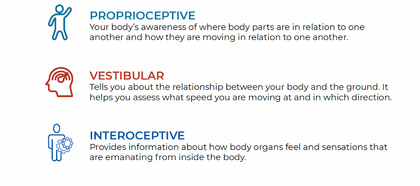
We all grew up knowing about our five senses—sight, sound, smell, taste, and touch. However, many people are unaware that we have three additional sensory systems.
- Proprioception – our awareness of the body’s position and movement
- Vestibular – related to balance and the spatial orientation of our body
- Interoception – awareness of internal sensations such as hunger, heart rate, or the need to use the bathroom
Our sensory systems work together to navigate our environment and ensure a sense of safety. When one or more of these systems detects a threat, our body becomes dysregulated, and learning becomes secondary. A student distracted by flickering lights, overwhelmed by noise, or craving movement is not ready or able to fully learn from instruction. Their bodies are focused on addressing the sensory information coming from the environment and determining how best to respond to those stimuli. The subconscious need to ensure body safety dominates the student’s mind and will overrule the teacher’s attempts to gain the students’ attention to engage them in learning.
The SEE-THINK-DO Process
When we see behaviors that indicate possible sensory dysregulation, we need a process to help us narrow down what may be at the root of the behavior. At All Belong, we focus on using the SEE–THINK–DO process to organize our observations, thoughts, and responses. We ask ourselves:
- SEE: What observable behaviors am I noticing?
- THINK: What might this behavior be communicating about the student’s sensory needs?
- DO: What strategies can I try to help the student re-regulate and return to learning?
This reflective process helps us, as educators, move from reacting—to responding with intentionality. It empowers us to think proactively to help students avoid becoming dysregulated and equips us with targeted strategies to use when we can see dysregulation setting in.
Practical Strategies for Regulation
There are numerous tools, exercises, and activities that can support sensory regulation. Creating a sensory-supportive environment doesn’t require a special room or expensive tools. It starts with awareness and a few accessible changes. Some easy to implement changes include:
- Flexible seating: Use wiggle seats, stools, ball chairs, and/or standing desks to help students who crave movement.
- Visual adjustments: Use natural light or lamps to reduce fluorescent glare, increased white space to limit visual stimuli, and/or a tri-fold display to create a private workspace to limit visual distractions.
- Auditory tools: Use noise-canceling headphones, soft background music, or a white noise sound machine to reduce noise distractions.
- Tactile options: Use fidgets, chewlery, crunchy snacks, or gum chewing to meet oral sensory needs for calming.
- Proprioceptive “heavy work”: Have the student carry books, push a loaded cart, or wipe tables to help ground an overstimulated body.
- Vestibular reset: Have the student rock in a rocking chair or swing back and forth to calm a frazzled nervous system and reset the student’s equilibrium.
Knowing your students’ sensory needs and responding with these or other simple practices sends a powerful message to students: You are known. You are safe. You can learn here. You belong.
Citation: Greene, R. W. (2008). Lost at school: Why our kids with behavioral challenges are falling through the cracks and how we can help them. Scribner.
Interested in learning more about sensory regulation and inclusive classroom strategies? Visit the All Belong Store for more tools, including our Individualized Emotional and Sensory Regulation Plan.