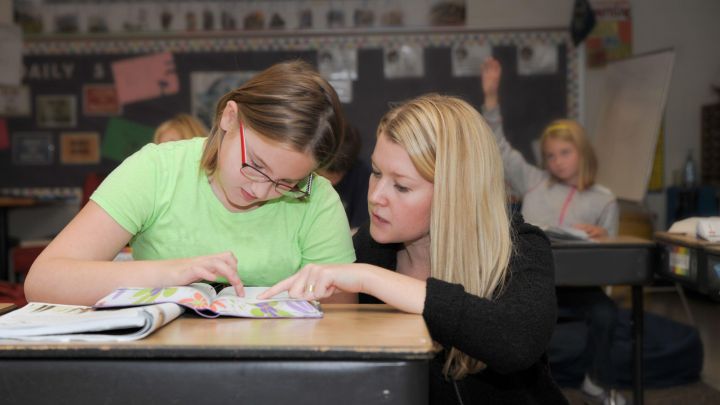
Differences in the Classroom: Changing How We See
Have you ever seen a toddler open a big gift only to play with the box that it came in rather than the toy that was inside? Ever made a race car out of a refrigerator box? Or hid in a box like a fort? A box can be a place of wonderful possibility for our imaginations, but it can also be a place to be confined.
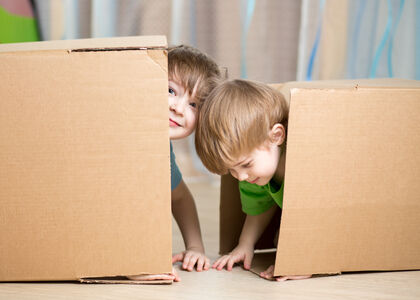
Boxes Divide Us
We love boxes, don’t we? We love to put people into them; deciding if someone is this or that, old or young, white or black. We are tall or short. We are average or above average. We are disabled or non-disabled.
How do we decide which box someone fits in? How do people we know, and people we don’t know, decide which box WE fit in? Is 50 old or young? Is 5’ 10” tall or short? I am ambulatory which (might) put me in the same box as runners. But does someone who can barely run three miles really fit in the same box as a marathon runner? I am able to speak, but do I belong in the same box as Billy Graham?
We are boxed up by those who have the power to name the box or define the category.
Danforth, in his book Becoming a Great Inclusive Educator (p. 88-92), outlines the medical model of disability that has been dominate in American society and has driven schools to diagnosis, label, and provide intervention, often within the box of separate classroom walls. While diagnosis is important and helpful in many ways—if it is used to sort and separate, rather than understand and include—it becomes a box that confines students. “The minute we build those boxes and build those sides there are kids who will not fit”, says E.L. Dombrowski. (Dykstra, S., 2022, 3:25)
Breaking the Boxes
What happens if we break down the sides of those boxes and create a line, a continuum, instead? If we can consider each human quality on a line rather than in isolated boxes, we can shift our thinking from dichotomy to diversity. Danforth goes on to explain the social model of disability in which human differences are seen as legitimate, and the labels that separate people are understood as socially constructed.
At All Belong, our school psychologists seek to know a student—the whole student—most excellently; in that evaluation process diagnostic labels are sometimes identified, but are understood as one piece of information about who a student is. At All Belong, the purpose of a student evaluation is not to sort the student into the appropriate box or program, but rather to understand the student in their utterly unique expression of God’s image—to celebrate their strengths and support their challenges in an interdependent way.
Diversity is valuable to community and living a life of interdependence. Celebration of differences frees us from seeing students as needing to be “fixed” and allows us to recognize their strengths and growth along a long line of diverse displays.
As schools of belonging, that is what we are doing: we are changing the way we see students. We are naming the ways each individual represents an image of God and brings unique gifts to our interdependent communities. We are understanding all minds and hearts as diverse, not just some. We are person, rather than program (box), centered.
“Dr. K. Strater says it this way. “Programs have boundaries; one can easily see the things that are in a program and things that are outside of a program. So these boundaries have the potential to create unintentional barriers to the things that fall outside of that program. Identity, on the other hand, is much more fluid and pervasive so it is harder to see the things that are in and out…So if we are less bound, we create fewer barriers making inclusion possible…It moves us away from discussions of problem of fit and it turns the discussion toward possibility, what can happen.” (Dykstra, S., 2022, 2:45)
Changing How We See
Jesus calls us to break down our boxes and enjoy the uniqueness of each image-bearer of God. Through the gift of salvation there is a new way to look at those around us. “So in Christ Jesus you are all children of God through faith, for all of you who were baptized into Christ have clothed yourselves with Christ. There is neither Jew nor Gentile, neither slave nor free, nor is there male and female, for you are all one in Christ Jesus.” (Galatians 3:26-28 NIV)
The children’s book, We’re All Wonders, ends with this line “I know I can’t change the way I look. But maybe, just maybe people can change the way they see. If they do, they’ll see that I’m a wonder.” Jesus gives us new eyes to see each other; do you see the wonders all around you when the sides of the boxes aren’t blocking your view?
Bibliography
- Danforth, Scot. (2017). Becoming a Great Inclusive Educator. Second Edition. Peter Lang Publishing, Inc. New York.
- Dykstra, S., (host). (March 31, 2022). The Inclusion Journey: From Program to Identity, with Dr. Kate Strater and Elizabeth Lucas Dombrowski. (Season 1 Episode 3). All Belong Podcast. https://podcasts.apple.com/us/podcast/the-all-belong-podcast/id1605647442
- Palacio, R.J. (2017). We’re All Wonders. First Edition. Alfred A. Knopf. New York.