
Restorative Practices Start With Everyday Conversations, Not Formal Programs
When schools hear “restorative practices,” they often think of circles, formal conferences, or major behavior interventions. But the truth is that restorative culture is built (or broken) in everyday interactions—not only in the big moments, but in the small ones.
As believers, we know that we are created for relationships and connection. In order to thrive in community, we need each other. The Bible is rich with stories of reconciliation, forgiveness, and restoration, calling us to lean into relationships and pursue repair when conflict arises. In Colossians 3:12-15, God calls us to community and forgiveness.
So the real question for leaders and teachers is—How do we make every interaction more restorative and redemptive?
What if every conflict became...
...an invitation to restore covenant relationships and community
...an opportunity to:
- name the harm
- understand the impact
- repent and take responsibility
- rebuild trust
According to the International Institute for Restorative Practices (IIRP),
“restorative practices…create a sense of belonging, minimize harm, and support student learning while cultivating students who are better equipped to navigate complex challenges, self-regulate, manage conflict, and become better citizens. They uncover the root causes of conflict and create a space to facilitate complex conversations to minimize harm, repair relationships, and identify solutions.” International Institute for Restorative Practices (IIRP)
As Christians, we believe God is our Creator and Redeemer, so this work goes deeper. In our schools, we are not just a group of individuals, but a body of image bearers called into relationship with God and one another. When harm occurs, it’s not just a rule violation. It’s a rupture in relationships.
Restorative practices help us move beyond superficial peace toward shalom, where relationships are made right through truth, grace, and restoration. In this way, students are formed as people who seek restoration and live in right relationship with God and others. Everyday conversations become opportunities to seek understanding, name harm and sin when needed, and participate in God’s work of healing and renewal in our community.
So how do teachers and leaders use a restorative approach to build community in our schools?
Small Shifts, Big Impact
Every time we ask, “Who was affected?”
instead of only “What rule did you break?”
Every time we pause to listen
instead of only reacting—
we are shaping a different kind of student, and a different kind of school culture. Restorative culture isn’t reactive. It’s proactive. That means consistent, self-aware interactions in small moments throughout each day and week.
The Power of Presence and Doing Things WITH Others
At its core, restorative practices believe that transformation happens when we walk alongside others, working with them, rather than doing things to them or for them.
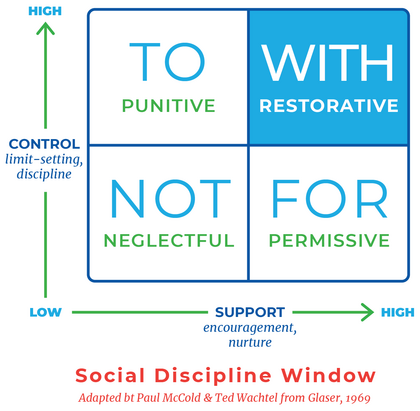
Matthew 1:23 introduces our Savior as Immanuel, God with us. Jesus modeled this by being present with the people around Him. In His goodness, our Father sent His Spirit to be present WITH us, and He continually invites us into a relationship with Him as partners in the gospel story of reconciliation and restoration, restoring us to Him and restoring us to one another. We are called to live and interact in community WITH others.
One way we live out this calling to be ‘with’ others is through restorative language, a framework for building relationships and navigating conflict by addressing harm, its impact, and next steps.
Principles of Restorative Language
At its core, restorative language fosters curiosity over judgment and builds empathy. It strengthens social awareness and relationship skills, helping us work interdependently and create spaces of belonging. Through the work of the Holy Spirit, we encourage both students and adults to grow in understanding, take responsibility for their actions, and pursue restored relationships that reflect God’s design for His people.
Restorative language invites us to
- Be a learner, not a judge (Adams, 2022)
- Focus on the issue rather than the person (deed vs. doer)
- Remain solution-focused
Practicing restorative language requires awareness of how we show up in conversations. We should consider our tone, facial expressions, and body language. Are we calm and genuinely interested? Does our face communicate care and concern? Is our posture relaxed, reflecting openness and respect? (Hopkins, 2021)
It also calls for intentional self-reflection. We can ask ourselves: What can I learn from this situation? What might the other person be thinking, feeling, or needing? Am I creating space for them to share their viewpoints? Am I considering what they need for closure and repair? Do I assume I fully understand the situation, or am I remaining open and curious?
Engaging in Restorative Conversations
While restorative questions are often associated with formal conversations after harm has occurred, we can use everyday conversations as opportunities to explore people’s stories, understand the impact of any harm done, and seek healing and renewal within community.
Think about a recent conversation you’ve had with a colleague, student, or parent. Which of these questions might have been helpful?
Exploring the story and the impact
- Can you tell me what happened?
- What do you feel like we need to talk through or figure out here?
- What were you thinking at the time?
- How has this affected you and others?
- What has this been like for you and others?
- How were you feeling then? How about now?
Looking ahead
- What do you think needs to happen next?
- What support would help moving forward?
- How can we work through this together?
Try this in your next conversation (with students, staff, or parents)
- Practice active listening- be present
- Be aware of tone, facial expressions, and body language
- Notice when you become a judge and reframe your thinking to become a learner. (Adams, 2022)
- Keep conversations going: “Go on…”; “Tell me more…”; “What I hear you saying is….is that right?”
As educators in Christ-centered schools, we can be the difference between rupture and repair, the difference between isolation and community. Let's ask ourselves:
Where might God be inviting us to move beyond keeping the peace and into true restoration in our daily interactions?
What might change if we saw every conversation as an opportunity to restore, not just respond?
Resources
Adams, M. G. (2022). Change Your Questions, Change Your Life: 12 Powerful Tools for Leadership, Coaching, and Results. Berrett-Koehler.
Hopkins, B. (2021). Review of Restorative Leadership: Skills and Processes That Can Support Leaders Model Restorative Day-to-Day Conversations, Meetings, Conflicts, Complaints, and Disciplinary Issues. Transforming Conflict.
International Institute for Restorative Practices (IIRP), https://www.iirp.edu/