Success in the Classroom: Can we redefine it?
When my son started seventh grade at a new school, he decided to join the cross-country team. He had never tried running before, but he thought being on the team might help him make a few friends. Well, it was a good thing friends were the goal because in his first-ever cross-country race, he crossed the finish line last.
When he graduated from college ten years later, he had competed in well over 200 races throughout middle school, high school, and college. For ten years, he trained daily, year-round—no matter the weather. For ten years, he tracked his progress, recorded his times, worked with coaches, recovered from injuries, and built relationships. For ten years, his family and friends cheered him on, celebrated with him, and encouraged him. For ten years, he raced, and he never won.

He never won according to the official, final time down to the tenth or hundredth of a second. He never won when compared to the runners around him. He never got the first-place medal nor stood on the first-place platform.
But as his parent, I never saw what he wasn’t doing. I saw what he was doing. I saw that his time in that race was ten seconds faster than his final time in the last race. I saw that he kept his pace more consistent than last year. I saw that his body was stronger than it had been years before. I saw that he was less physically and mentally tired than before. Each time he crossed the finish line, I found a true celebration of his success (even when he couldn’t). Why is that?
Individualized Definitions for Success
The answer is simple: we defined success for him as an individual, not relative to others. By knowing him really well and defining success differently than the official race statisticians, we could find true joy, mark true progress, and feel true pride for our son. His efforts brought success as defined by him/us.
Can we think of each of our students in a similar way? Can we know where they started with reading and celebrate their small gains? Can we define success not by what the other students in the classroom are doing, but rather by what we can identify as a new skill or quality for that particular student?
I see teachers doing this all the time when they tell me stories of a student who made eye contact for the first time, read a book on their own for the first time, passed the history test using a scribe, or entered the classroom with a smile instead of tears.
As Christian teachers in Christ-centered schools, we have the unique opportunity and, I would even say, call to “see” success differently. To use the eyes that God uses when He looks at his children. In the Bible, we encounter a counter-cultural view of success. In the parable of the talents (Matthew 25) and the Sermon on the Mount (Matthew 5), Jesus turns our culturally bound definitions of success and fairness on their heads. In 1 Samuel 16:7b (NIV), we read, “The Lord does not look at the things people look at. People look at the outward appearance, but the Lord looks at the heart.” God calls us and frees us to recognize the image of God that shows itself uniquely in each of His children—with unique strengths and manifestations of the fruits of the Spirit that reflect back God’s glory and contribute to the fullness of His creation.
Person-Guided Planning Redefines Success
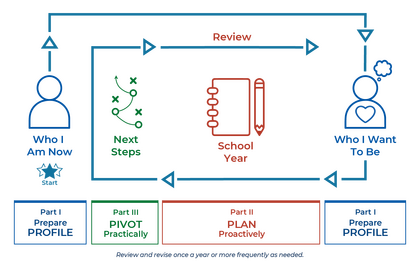
At All Belong, we use Person-Guided Planning as a tool for defining success on an individual level. Person-guided planning begins with knowing the student excellently by preparing a profile. This profile is built from parent and student input, an understanding of the student’s childhood history, their current relationships, and their strengths and challenges.
The next step is the process of Vision Casting— we ask students and their parents to dream about the future. What does the student hope to do independently? Where does the student hope to live? How do they hope to contribute to their church or community? Spend their free time?
After the current profile and future goals have been identified, the team works backward to identify personalized goals that point the student and their support team toward the student’s vision. Working toward goals that are appropriately leveled and relevant for the student’s short and long-term plans creates benchmarks that are achievable. Measuring growth in a way that is student-driven increases the opportunities to mark and celebrate success. Celebrating individual success is what keeps teachers and students going. It is the joy of teaching and learning.
Person-guided Planning Empowers Teachers
Individualized student goals identified in Person-Guided Planning not only set the student up for success, but also free the student’s teachers to focus on what is important for the student. Teachers can set aside or modify academic or behavioral expectations and focus on the most important next steps for the student. In other words, teachers are given a different measuring stick to use. Standards, grades, or national norms are no longer what dictate success; the student and their support team decide where and when success is found. Teachers find this new way of measuring to be as exciting and motivating as the students do.
Just as I found reasons to celebrate each one of my son’s races, teachers, parents, and students can find many reasons to celebrate when they define or redefine success for the individuals they know excellently. Let’s encourage each other to get some new measuring sticks out.
Marji Voetberg
Teacher Consultant and Educational Resources Manager
Marji Voetberg, a Teacher Consultant and Educational Resources Manager at All Belong, has spent over 25 years working in Christian inclusive education environments. Marji's passion for the beauty and benefits of an inclusive environment for all God's children has only increased throughout these years. When not at work, Marji can be found hiking, biking, walking, or cheering her kids on at their events.