The Complex Power of a Simple Process
The author of this blog, Becca Berbaum, attended the All Belong Head and Heart Conference in 2024 where she learned the Three-Step Process. This process had such a positive impact on her work with students at Wheaton Academy that she felt compelled to write about it. We thank Becca for sharing her story with us and with you all.
Before I joined Wheaton Academy, a Christian High School in West Chicago, IL, All Belong’s partnership had already fostered an imagination for inclusive education among administrators and teachers. I was hired in August to fill the newly created role of Educational Support Specialist, and I felt as though I had walked into a garden that had already been tilled and fertilized, ready for the seeds of new ideas to support all students.
I knew I had good ideas to contribute, but as a newcomer to this community, I was often unsure how to pace and prioritize the work of accelerating inclusion. Every month, Liz Fox, who has been partnering with Wheaton Academy for years, came in like a master gardener, affirming these valuable “seeds”, helping me think strategically about where and when to plant them, and offering a few new ones at each visit. She and our administrative staff encouraged me to attend the Head and Heart Conference. I had already begun collecting teacher observations for a few struggling students using the “What Do We See” tool in the Member Center, so the content in each conference was immediately applicable to the work I was doing.
One of these students, Andrew (not his real name), a high school sophomore, had failed one class the year prior and had fallen significantly behind after a bout of illness during the first semester of this school year. A few caring teachers had reached out to our student services team, wondering if a learning disability might be contributing to the challenges he was facing. At this time, I had read Your Students, My Students, Our Students Rethinking Equitable and Inclusive Classrooms because it was All Belong’s book study selection. I was certainly influenced by the research data referenced by authors Lee Ann Jung, Nancy Frey, Douglas Fisher, and Julie Kroener in one of the early chapters, indicating that it could be fruitful to create an accommodation plan on the basis of observational data, even without a formal disability “label” from an expensive neuropsychological evaluation. I shared this research with our student services team, and proposed that we initiate our consideration of a possible Individualized Student Plan (ISP) for Andrew using All Belong’s Three-Step Process— instead of starting with a request for an evaluation. Our team was interested in exploring this approach.
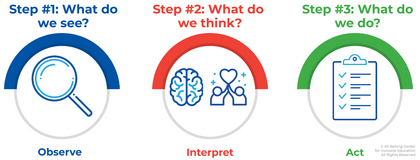
At the Head and Heart conference, Part 1, I learned to use observable language and to become a splitter instead of a lumper by noticing specific strengths and weaknesses. At the Head and Heart conference, Part 2, I learned how to communicate these insights and include students, teachers, and parents in the work of applying helpful strategies. Shortly after this conference, I met with Andrew’s mom to pull together the Three-Step Process. I was hopeful that these seeds would bear good fruit in our conversation.
To say so would be an understatement. Andrew’s mom was so moved by our meeting. She felt that her son was truly seen and loved. She nodded vigorously as I shared observations together, and she shared similar stories from Andrew’s childhood. We shared the joy and wonder of Andrew’s strengths and the sadness of knowing that Andrew was so discouraged about his weaknesses. Andrew’s mother expressed that she had been afraid to consider the possibility of a learning disability, in part because some of her peers in the Czech Republic were treated with contempt on account of their disabilities and still live lives of defeat and shame. She said, “after talking with you, I’m not afraid. I think if you talked to Andrew the same way you just talked with me, I think he would see that the teachers here really see who he is and care about him and don’t want him to struggle alone.”
“After talking with you, I’m not afraid… I think he would see that the teachers here really see who he is and care about him and don’t want him to struggle alone.” Andrew's mom
I realized in that moment that starting with a request for a neuropsychological evaluation might have been detrimental to our relationship with this family and created a barrier to helping Andrew thrive. We discussed the potential benefits of a full evaluation for both understanding and advocacy, and Andrew’s mom felt comfortable discerning this option with her son. I was so thankful for the observable and demystifying language I was given by All Belong to use in this conversation. I was able to affirm the reality that Andrew was wonderfully made by God for good works planned long ago, and that interdependence was part of God’s good design for Christian community. Quite practically, this was an incarnational conversation, for I was equipped to be an ambassador of the God who sees, loves, and desires to meaningfully include Andrew in his kingdom.
Andrew and I had our conversation yesterday, and his mom was right. I think he understands better than ever how much he is known, seen, and cared about here at Wheaton Academy. We can now create an ISP together on this foundation. Thank you, All Belong, for doing your part to equip the saints for ministry.
Becca Berbaum is an Educational Support Specialist at Wheaton Academy, a Christian High School in West Chicago, IL. She has a wide range of experience in education, including public, private, virtual, and homeschooling. Becca has a B.S. in Special Education from Illinois State University and is a School of Ministry graduate from the Alliance Center for Leadership Development.